

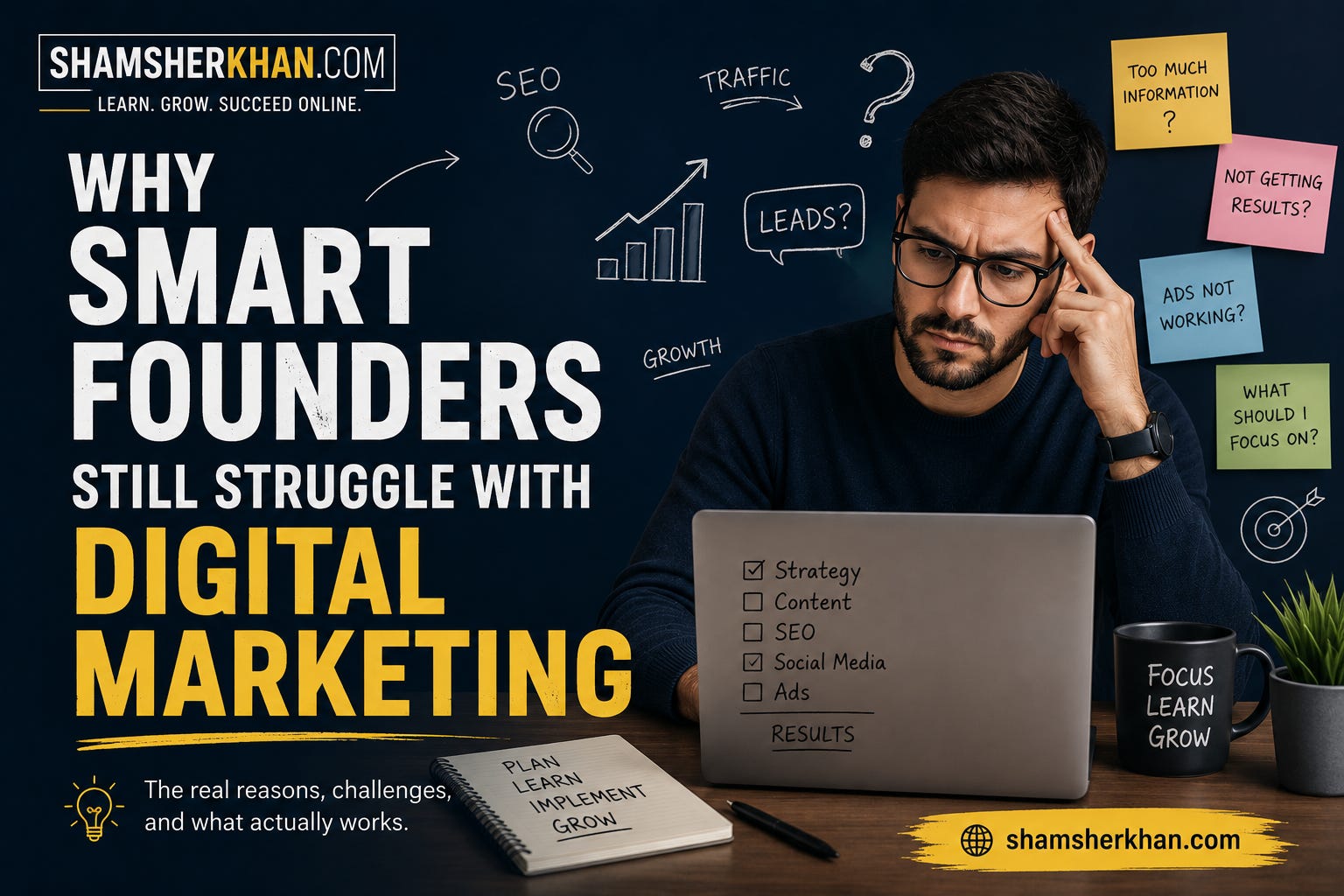
Why Even Smart Founders Still Struggle With Digital Marketing

Many founders assume digital marketing is simply about running ads, posting on social media, or hiring an agency. Yet even highly intelligent entrepreneurs with strong products and ambitious visions often struggle to generate consistent traffic, leads, and customers online.
The problem usually isn’t a lack of effort.
It’s a lack of clarity, direction, and practical understanding of how digital marketing actually works in today’s competitive environment.
Being Smart in Business Doesn’t Automatically Mean Understanding Marketing
A founder may be excellent at:
product development
operations
finance
sales
technology
leadership
But digital marketing is a completely different skill set.
Modern online marketing combines:
psychology
consumer behavior
search engines
content strategy
branding
analytics
algorithms
communication
consistency
Many founders underestimate how broad and fast-changing the field really is.
As a result, they often jump between tactics without building a strong marketing foundation first.
The Biggest Reasons Smart Founders Struggle With Digital Marketing
1. Information Overload Creates Confusion
Today, founders are surrounded by endless advice:
YouTube tutorials
LinkedIn “gurus”
Twitter threads
AI tools
online courses
webinars
marketing podcasts
Everyone claims to have the perfect strategy.
One person says SEO is everything. Another says SEO is dead. One expert recommends short-form video while another says email marketing has the highest ROI.
The result is confusion instead of progress.
Many founders consume huge amounts of marketing content but still don’t know:
where to start
what matters most
what applies to their business
what should be ignored
Learning without a clear roadmap often leads to scattered execution.
2. They Focus on Tactics Instead of Fundamentals
Many businesses rush into:
Facebook ads
TikTok content
SEO tools
AI automation
viral trends
Before understanding the fundamentals:
Who is the target audience?
What problem are they solving?
Why should customers trust them?
What message actually converts?
What makes their offer different?
Without strong fundamentals, even expensive campaigns fail.
Digital marketing is not just about visibility. It’s about communicating value clearly to the right audience.
3. Founders Expect Fast Results
One of the biggest misconceptions in digital marketing is speed.
Many founders expect:
instant SEO rankings
immediate sales from ads
viral social media growth
overnight brand awareness
But sustainable marketing usually takes time.
SEO can take months.
Content marketing requires consistency.
Brand trust builds gradually.
When quick results do not appear, founders often:
switch strategies too early
abandon channels prematurely
lose consistency
blame the platform instead of the process
The businesses that succeed in marketing are often the ones that stay consistent long enough to learn what works.
4. They Try to Learn Everything Alone
Many entrepreneurs attempt to become:
SEO experts
content creators
ad managers
social media strategists
web designers
copywriters
All at the same time.
This creates burnout.
Digital marketing has become too large and specialized for founders to master every area quickly without guidance.
The smarter approach is learning:
the fundamentals
decision-making skills
strategic thinking
how to evaluate marketing properly
Founders do not need to become full-time marketers. They need enough understanding to make informed decisions and avoid costly mistakes.
5. Most Online Marketing Education Is Too Generic
A major frustration for founders is that many marketing courses teach theory instead of practical implementation.
Generic advice like:
“post consistently”
“know your audience”
“create engaging content”
Sounds useful but often lacks real-world context.
Small businesses and startups face very different realities compared to large brands:
limited budgets
limited time
small teams
pressure for fast growth
resource constraints
What founders need is practical guidance tailored to their actual stage of business.
6. Marketing Feels Uncertain Compared to Other Business Functions
In areas like finance or operations, results are usually measurable and predictable.
Marketing feels different.
Sometimes:
great content gets ignored
weak content goes viral
ads fail unexpectedly
rankings fluctuate
campaigns perform inconsistently
This uncertainty frustrates analytical founders who prefer clear systems and predictable outcomes.
But digital marketing is partly data and partly human psychology. There is no universal formula that works for every business.
The most successful marketers continuously test, learn, adapt, and improve.
7. They Underestimate the Importance of Messaging
Many businesses focus heavily on:
logos
websites
design
tools
automation
But weak messaging quietly destroys conversions.
If a business cannot clearly explain:
what it does
who it helps
why it matters
why customers should trust it
Then traffic alone will not solve the problem.
Strong messaging is often more valuable than expensive marketing campaigns.
Why Personalized Learning Works Better for Founders
Many founders do not need another generic course.
They need:
clarity
direction
accountability
practical implementation
feedback specific to their business
This is why one-to-one coaching and personalized marketing guidance are becoming increasingly valuable.
A personalized approach helps founders:
avoid unnecessary distractions
focus on the right strategies
understand what actually matters
learn faster through real application
Instead of learning random tactics, they develop strategic thinking.
The Real Goal Isn’t Becoming a Marketing Expert
Founders often believe they must master every aspect of digital marketing.
That is not necessary.
The real goal is:
understanding enough to make better decisions
recognizing what works and what doesn’t
building a sustainable growth system
communicating value effectively online
A founder with strong marketing understanding gains a major competitive advantage.
They can:
hire smarter
market more confidently
reduce wasted spending
grow more predictably
adapt faster to changes
Final Thoughts
Smart founders struggle with digital marketing not because they lack intelligence, but because modern marketing has become noisy, complex, and constantly changing.
The challenge is not access to information.
The challenge is knowing:
what matters
what to ignore
what works for your specific business
how to apply marketing consistently in the real world
The businesses that succeed online are rarely the ones chasing every trend.
They are usually the ones that build strong fundamentals, stay consistent, understand their audience, and continue learning strategically over time.
If founders can shift from random marketing activity to focused learning and practical execution, digital marketing becomes far less overwhelming — and far more effective.
If you are tired of random marketing advice and want structured one-to-one guidance tailored to your business goals, visit:
Start learning digital marketing with clarity, strategy, and personalized support.