

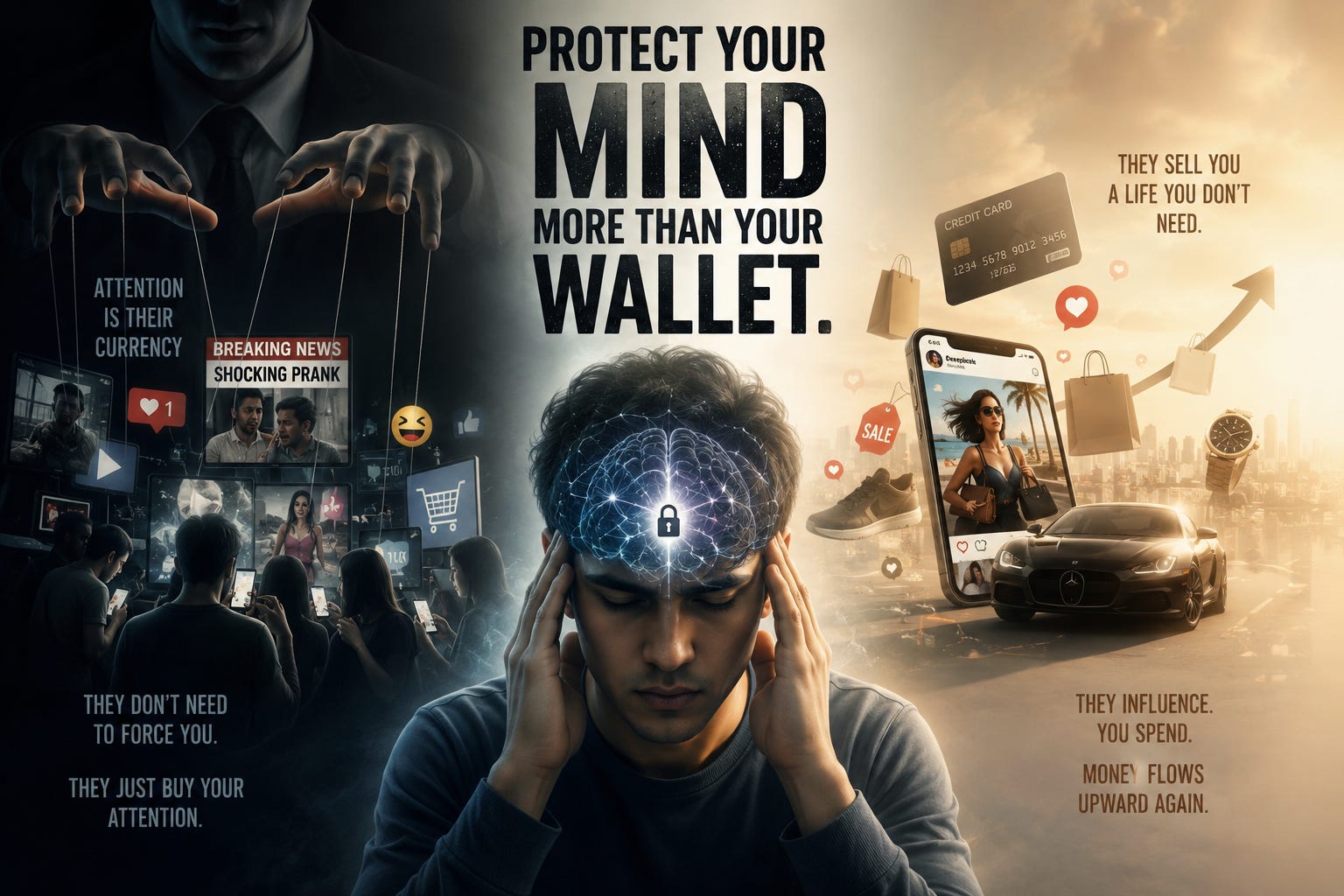
Protect Your Mind More Than Your Wallet
The greatest battle today is not for your money first — it is for your attention, your thinking, and ultimately your behavior.

For decades, people believed the economy mainly worked like this:
The rich owned companies.
The poor worked jobs.
Money flowed upward through labor.
But the modern world changed the system.
Now many people are not only working for powerful companies — they are unknowingly marketing for them too.
And once you notice this pattern, you begin seeing it everywhere.
A viral video spreads online.
Millions watch it.
People argue in comments.
Algorithms push it harder.
Brands sponsor the creator.
Products get sold.
Attention becomes revenue.
But look carefully at who is usually being used in the process.
Very often, it is ordinary struggling people.
Recently, prank content humiliating poor people on streets has become common “entertainment.” Not billionaires. Not celebrities with power. But vulnerable people with little protection against public embarrassment.
Then creators monetize those moments:
Sponsorship deals
Affiliate promotions
Merchandise
Brand partnerships
Ad revenue
The audience watches.
The algorithm rewards outrage and emotion.
Money quietly flows upward again.
This is bigger than YouTube.
This is the modern attention economy.
Today, the most valuable resource is no longer oil, land, or even labor alone.
It is human attention.
Because attention influences behavior.
And behavior controls spending.
That is why massive technology platforms spend billions studying:
Human weakness
Emotional triggers
Insecurity
Loneliness
Fear of missing out
Social validation
Dopamine responses
Every swipe, click, pause, and reaction teaches algorithms how to keep people engaged longer.
Most people believe they are simply consuming content.
But often, content is shaping the consumer.
People are being trained every day to:
Spend emotionally instead of rationally
Compare their lives constantly
Chase unrealistic lifestyles
Seek validation from strangers
Stay distracted from long-term goals
React instantly instead of thinking deeply
The dangerous part is that this system rarely feels forced.
Nobody is standing over people demanding attention.
Instead, entertainment makes the process feel voluntary.
Infinite scrolling feels harmless.
Trending videos feel natural.
Online drama feels addictive.
Luxury lifestyles feel aspirational.
But slowly, attention becomes captured.
And once attention is captured, money usually follows.
That is why many companies today care less about owning factories and more about owning screens.
If a platform controls attention:
It can influence trends
It can influence desires
It can influence opinions
It can influence purchasing decisions
It can shape culture itself
The economy no longer fights for your labor first.
It fights for your mind first.
Because whoever controls attention eventually influences behavior.
And whoever influences behavior often controls profit.
This is why protecting your mind is becoming more important than protecting your wallet.
A stolen wallet can sometimes be rebuilt.
But years of manipulated thinking, constant distraction, emotional consumption, and addictive digital habits can quietly reshape an entire life.
Protecting your mind today means:
Choosing what deserves your attention
Questioning emotional manipulation
Avoiding constant comparison
Limiting algorithm-driven consumption
Thinking independently
Spending intentionally
Building focus in a distracted world
The modern economy rewards those who can control attention.
But the future may belong to those who learn how to protect their own.